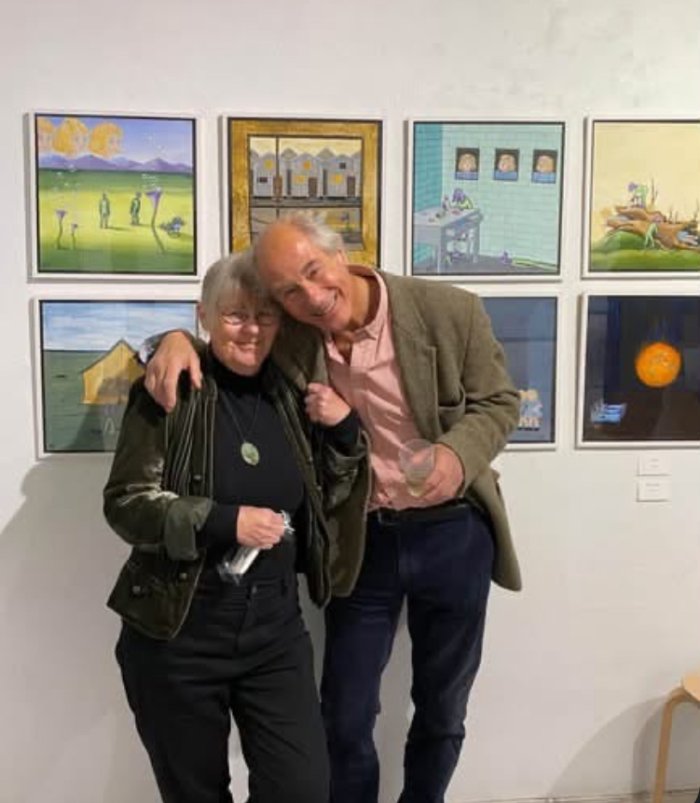
As the exhibition approached, Eric got in touch, and it turned out we had a surprising number of mutual friends on Facebook. Yet I had absolutely no recollection of him. For a while, I wondered: *Is he me? Am I him? Have we somehow met in different dimensions?* At the opening, however, we established that this was not the case.
It was a group exhibition at our gallery featuring several ceramic artists from Konstfack University of Arts, Crafts and Design. There were many truly remarkable works, among them Eric’s porcelain cowboys.
You have a background as a successful musician. What led you to turn to visual art?
Haha, “a background” makes it sound as though I’ve hung up my guitar for good. I’m still at it, perhaps more than ever, actually! But visual art has taken up an increasingly important place in my life over the past few years. I spent two years at Idun Lovén Art School, and I’m now in my second year studying Ceramics and Glass at Konstfack.
After more than thirty years in music, there’s something incredibly liberating about working with a material I don’t entirely know what I’m doing with. Being a beginner again, even though, of course, I bring my experience of creating things with me. I like that state of mind where curiosity outweighs control. When you make something and suddenly think, *What the fuck is this?* And then you want to keep going to find out.
Is this like you simply expanded your toolbox?
Expanded my toolbox, absolutely. I’m still writing, playing and making records. I’m probably trying to get at much the same things, but they take different forms. Sometimes something needs to become a song, sometimes a painting or a small, crooked figure.
There’s also a kinship in the way I work. I try something, listen or look, make changes, and try to sense when it starts to come alive. I can be moved by a voice cracking or a figure that’s barely holding itself together. There’s something in that I want to preserve. I don’t want to polish away the very thing that made me feel something in the first place.
What kind of art is closest to your heart?
I’m drawn to art that allows humour and seriousness to coexist. Something that might look quite funny or childish at first, but becomes sadder or more unsettling the longer you look at it. I’m interested in things that are crooked, tender and a little unsuccessful.
Both painting and sculpture are close to my heart, ideally working in harmony. I like it when colour and material are allowed to take up space, and when you can sense that someone has worked, hesitated, changed their mind and perhaps lost control for a moment. I like a little friction.
In my own work, I keep returning to the roles we play, the longing to be seen, and our attempts to reach one another. The adult and the child that remain inside us.
How did you arrive at the little ceramic cowboys, and how did they come into being?
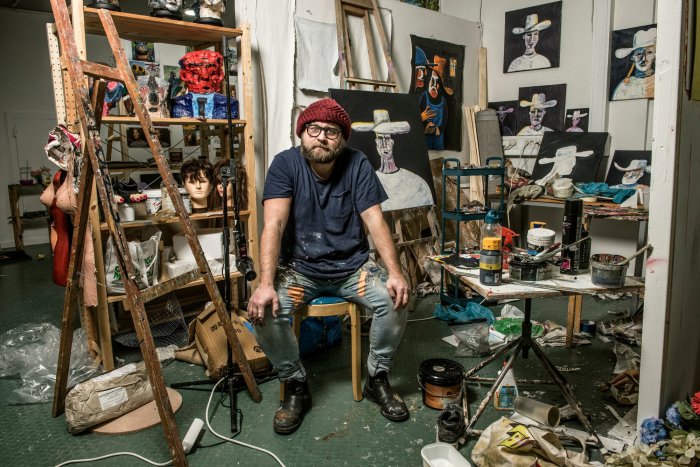
It actually started with paintings that I exhibited at Riche, which I’ve now translated into ceramics. What interests me about the cowboy is that we already carry such a strong idea of who he’s supposed to be: independent, decisive and tough. Someone who can manage on his own and simply ride off into the sunset.
My cowboys have a little more trouble with all that. They’re messy, broken, sometimes quite comical. They might be trying to strike a pose, but it doesn’t quite work out. The series is called *Smeared and Broken Cowboys*. For me, there’s a great deal of tenderness in them. I recognise myself in the gap between how you want to appear and how you actually feel.
In the process, I let the material have a say in what happens. Distortions and things that might initially feel like failures can give a figure its personality. These little figures can carry some pretty big emotions. You have to get close to them, and I like that.
You’re originally from Gotland. When did you leave the island, and how do you think Gotland may have shaped you as an artist and as a person?
I left Gotland after finishing upper secondary school in 1993, but I return often to work there, both with music and visual art.
I think a place you grew up in continues to exist within you, even when you live somewhere else. For me, that means both the actual landscape and an inner landscape made up of memories. Places, people and earlier versions of yourself, all layered on top of one another.
There’s also something about growing up on an island. The sea is both an opening and a boundary. The longing to leave and the longing to return can exist at the same time. I think that duality has shaped me. Gotland is a real place I return to, but it’s also a place I carry with me.
What do you think is the purpose of making art, for the individual and for humanity as a whole, if there is one?
For me, creating is a way of being in the world and trying to make contact. Both with parts of myself I don’t entirely understand and with other people. You make something deeply personal, perhaps even a little embarrassing, and then it turns out that someone else recognises themselves in it. I find that both strange and beautiful.
Play is central to me. As an adult, it’s easy to feel that everything has to lead somewhere, be good or have a justifiable purpose. Creating offers the possibility of exploring something without knowing what it’s going to become. I need that freedom, even though I’m also quite good at sabotaging it by turning the whole thing into a performance.
I think we need spaces where contradictions and things we don’t understand are allowed to exist. Where we can feel several things at once. And where someone else’s way of seeing the world can suddenly make our own world a little bigger.
What does the near future look like?
I’ll continue at Konstfack and want to give both sculpture and painting room to develop. There’s a lot I want to try, and one challenge is finding the time to stay with the work while also wanting to show it and bring it into contact with people.
I’ll also continue the musical performances I do with Catti Brandelius, where we bring art and music together. Our next appearance will be at the Gothenburg Museum of Art on October 23.
Music continues on other fronts, too. With EP’s Trailer Park, we’ll be touring throughout the rest of the year with our interpretations of Neil Young. In early 2027, my fifth solo album, *Under Influensen*, will also be released. On it, I interpret songs from the Swedish songbook, and I’ll be playing a few concerts in a stripped-back format to accompany the release.
So there’ll probably be more clay, paint, songs and quite a lot of things to carry around. I want to stay curious and keep trying to make room for the unexpected.